
Understand the economics behind your decisions
Connect client activity, inventory, financing, and firm funding to evaluate their combined impact on profitability, liquidity, and balance sheet usage.
Understand where inventory comes from and how it is used
Securities may be available in one part of the business while another desk relies on external borrowing. A connected inventory view helps teams understand availability, utilization, and the economics of internal allocation.
Fluent traces securities from source to use across client positions, firm inventory, financing, counterparties, and legal entities.
- Identify available and unencumbered inventory.
- Examine internal utilization and external borrowing.
- Investigate over-borrowing and underutilized positions.
- Generate axes informed by inventory and funding objectives.

Understand returns after resource costs
Revenue alone does not explain the value of a client or counterparty relationship. Funding requirements, portfolio composition, and balance sheet usage affect its contribution to the business.
Fluent connects positions, balances, pricing, and funding to a consistent traceable view.
- Compare financing P&L, ROA, P&L spread, and funding costs.
- Segment clients and counterparties by business characteristics.
- Investigate the positions and contracts driving performance.
- Track changes in profitability and resource efficiency over time.

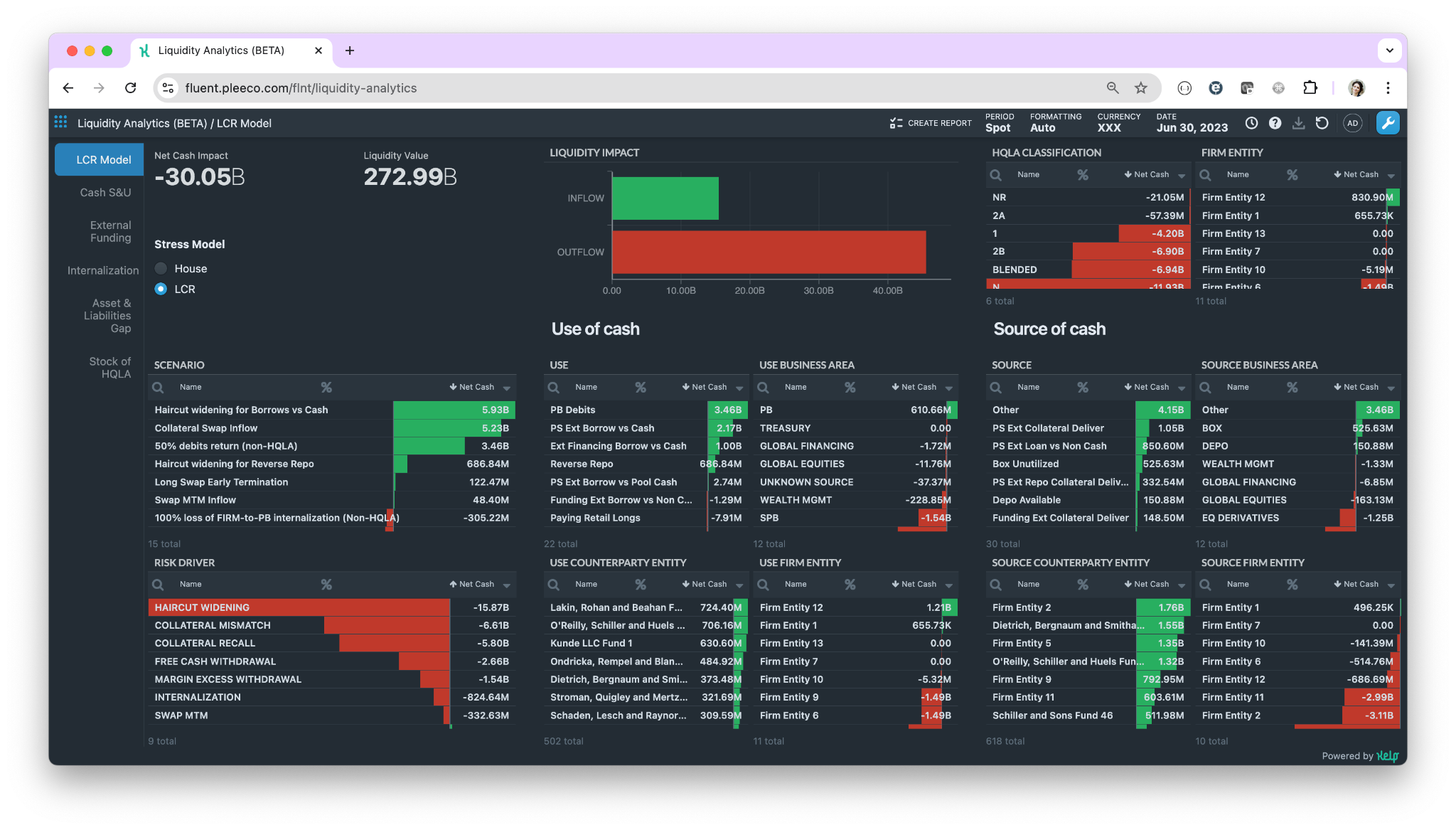
Explain funding demand and liquidity consumption
Funding decisions depend on how client activity, financing arrangements, and inventory interact across currencies, entities, and time horizons.
Fluent connects sources and uses of cash to funding structure, cost, and expected cash flows.
- Identify clients and activities driving funding demand.
- Analyze secured, unsecured, and internal funding sources.
- Examine maturity ladders and expected cash inflows and outflows.
- Calculate blended cost of funding.
- Analyze regulatory liquidity metrics, including LCR and NSFR, alongside HQLA composition.
Relate capacity consumption to economic contribution
Balance sheet capacity is shared across clients and business activities. Understanding who consumes it, and the returns that consumption generates, helps teams evaluate allocation and pricing choices.
Fluent connects balance sheet usage to the portfolios and activities behind it.
- Analyze consumption by client, desk, business line, and entity.
- Compare profitability with resource usage.
- Investigate the funding and inventory relationships behind aggregate measures.
- Monitor changes in utilization and efficiency over time.
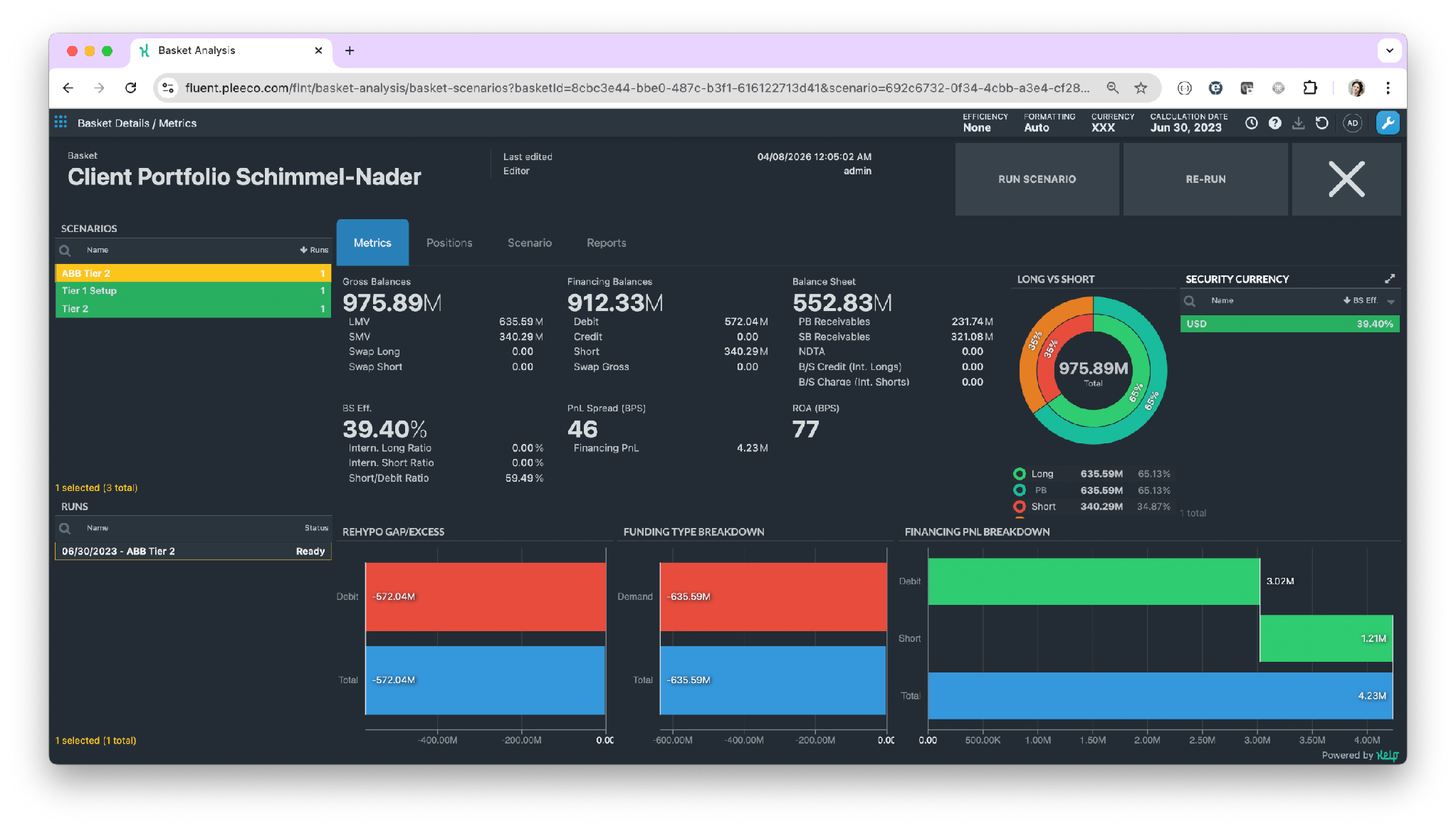
Evaluate the impact before conditions change
A proposed basket can have different economics on its own and within an existing portfolio. Client outflows and stressed unwinds can also create funding needs that change from day to day.
Fluent supports portfolio what-if analysis and liquidity stress scenarios using configurable assumptions.
- Compare multiple baskets and scenario configurations.
- Assess incremental P&L, funding, internalization, and balance sheet impact.
- Model client outflows under favorable and unfavorable unwind assumptions.
- Project daily cash flows and identify peak liquidity needs.
Start with your highest priority question
Pleeco can configure the relevant applications around your data, business definitions, and decision process.